Field Manual
The World Map
One map, 195 nations, every commander on it. Territory is held in percentages rather than flags, so ground is taken gradually — and lost the same way.
01 // The world
Every border is somebody's
There is one world and everybody plays in it. The nations you see on the map are the same nations every other commander sees, in the same state, at the same moment.
Ownership is fractional. A country is not a flag you either hold or do not — it is a percentage, and several commanders can have a stake in the same nation at once. Contested ground counts for nothing until it actually falls, which means a war is a campaign rather than a single roll.
- 195
- Nations
- 1
- Shared world
- 24/7
- Always running
- 0
- Downloads
The map
Survey before you commit
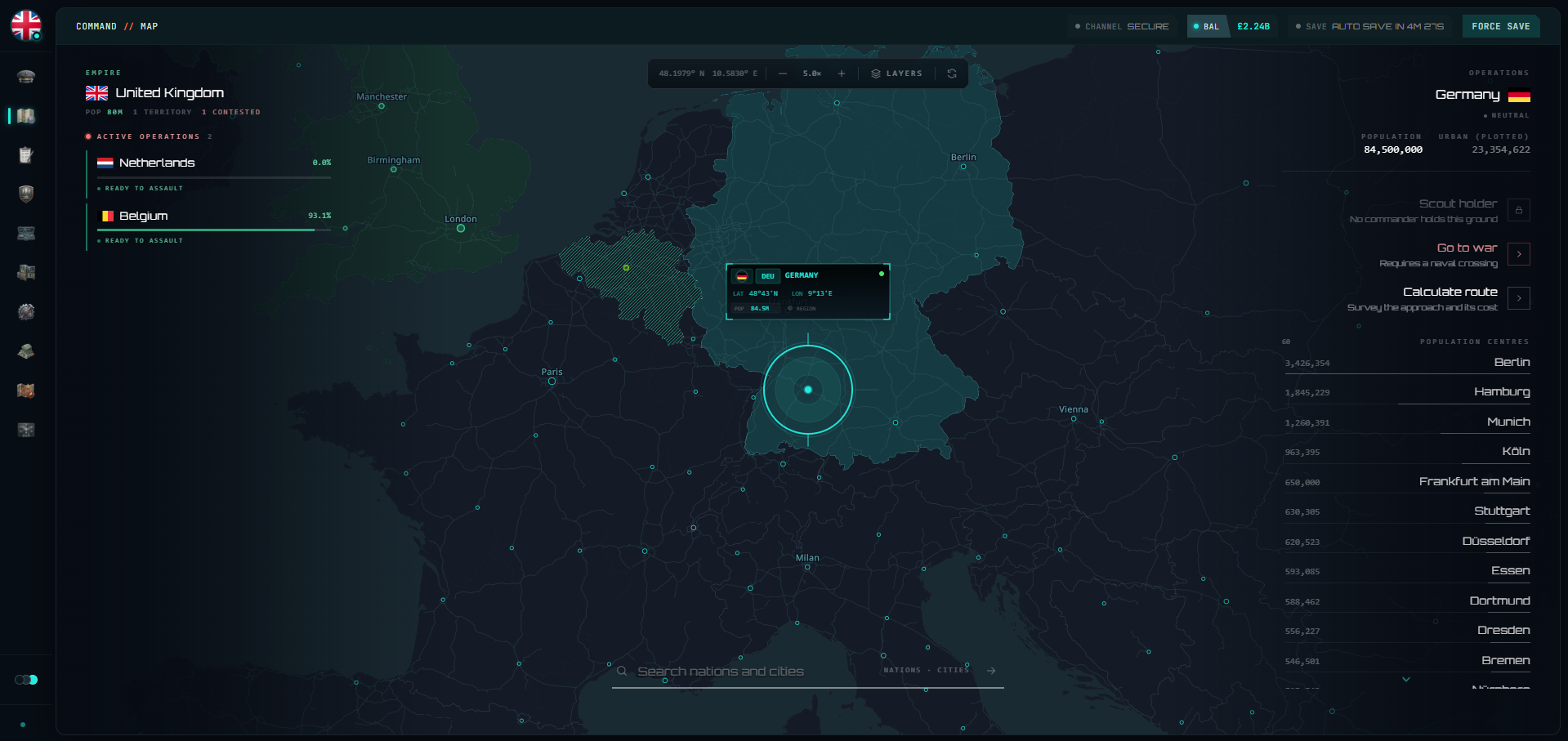
Every nation carries a dossier: who holds it and by how much, its population and infrastructure, and what an approach would cost you. You can read the whole picture before spending anything.
- Live territory and active fronts across every nation
- Ownership shown as a percentage, per commander
- Approach costs calculated before you commit
02 // Geography
Distance is a real cost
You cannot march an army through a country you do not hold. Land routes may only cross your own territory or an ally's — everything else has to go by sea, and sealift is priced on distance and the size of the force.
That single rule is what turns the map into a strategy rather than a list of targets. Taking a neighbour does not just add territory; it opens a land route to everything behind them. A campaign is planned in the order the borders allow.
03 // War
How a campaign runs
- 01Assess the targetA pre-battle briefing estimates your odds and breaks the balance down by land, air and sea — showing exactly which domain is costing you.
- 02Open the warDeclaring starts a campaign against that nation rather than a single battle. Progress is tracked as a capture percentage.
- 03Commit assaultsEach engagement is resolved by the server, with casualties and plunder settled there. Assaults are limited to one every five minutes.
- 04Close it outThe war ends when capture reaches 100%. Then the harder job starts, because everyone else can see what you now hold.
04 // Intelligence
You never see everything
Scouting a rival returns an approximation, not a readout. Enemy strength is reported as a rough figure that varies between looks, and activity is shown as a band rather than a timestamp.
Both are deliberate. Exact counts would make war arithmetic instead of judgement, and an exact last-seen time would let anyone build a profile of when a real person is at their desk. You get enough to decide, and no more.
- Approximate strengthUnit counts are reported with deliberate variance — close enough to plan against, never precise enough to bank on.
- Activity bandsYou see whether a commander is active today or has been away a while. You never see exactly when they were last online.
- Server-decided outcomesCasualties, plunder and capture are all settled by the server, so the result is the same for both sides of the fight.