Field Manual
Economy and Trading
Every operation you run is paid for from the treasury, and every territory you hold pays back into it. The army is downstream of the balance sheet.
01 // The principle
War is an accounting problem
Income scales with the territory you hold and the infrastructure you invest in. Upkeep scales with the army you field. The gap between them is your capacity to act, and managing that gap is most of the game.
Because production is charged per cycle rather than up front, an over-committed treasury does not fail loudly — lines simply stall when they cannot pay. Keeping the cash flow ahead of the production queue is the discipline the game actually tests.
The treasury
Every figure in one place
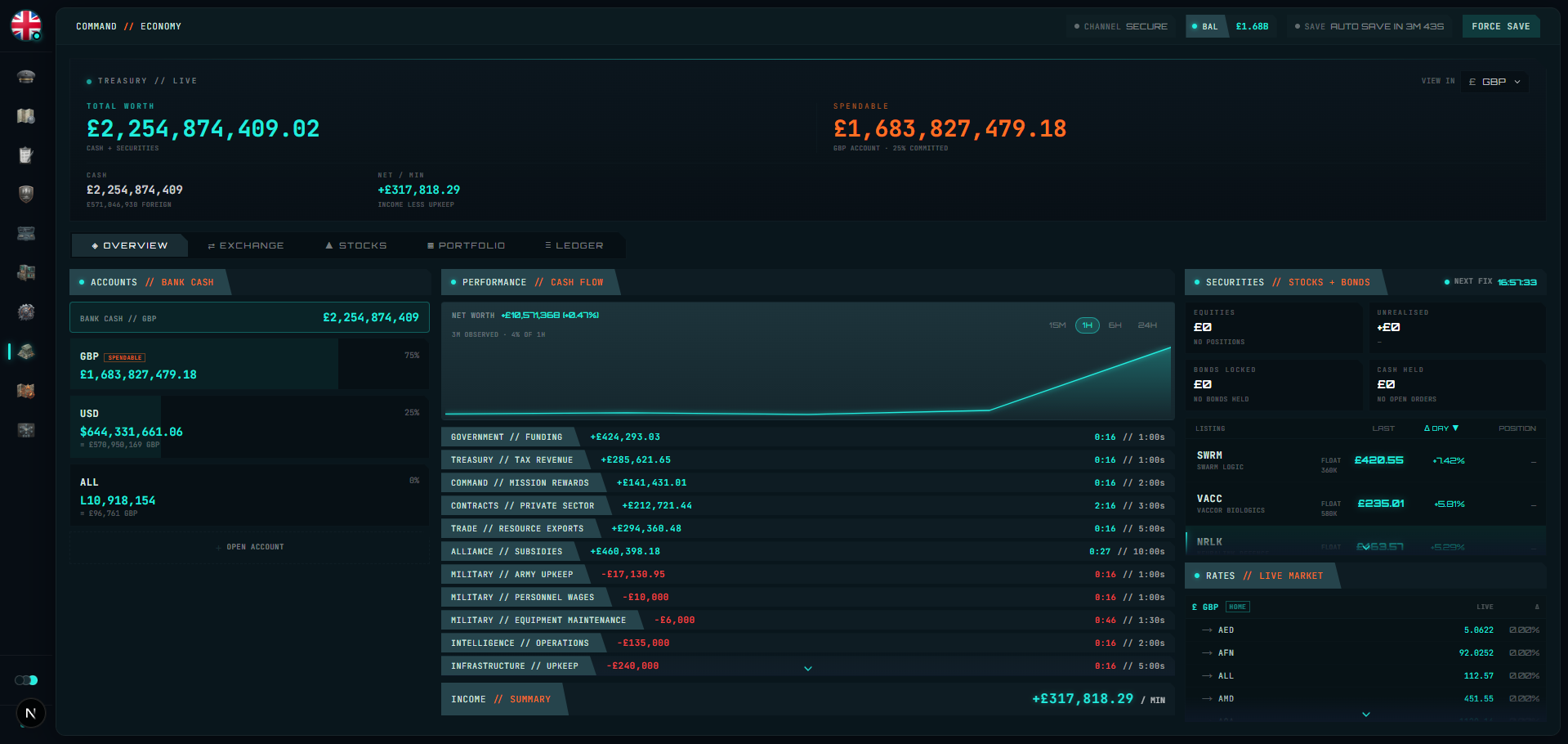
Multi-currency accounts, a cash-flow ledger down to the individual line, and your net worth tracked over time. Nothing is hidden in a summary — you can trace any number back to the transaction that produced it.
- Accounts held in your nation's own currency
- A full ledger of income and expenditure
- Net worth tracked across cash, holdings and bonds
02 // The market
A daily fix, not a ticker
Currency and commodity prices are set by a single daily fix at 14:00 UTC. Between fixes the board is stable, and every commander in the world is trading against the same numbers.
That design is deliberate. A second-by-second ticker rewards whoever happens to have the tab open; a daily fix rewards whoever read the board and planned around it. You do not need to watch the market to trade it well.
- One price for everyoneThe fix is server-set and shared. There is no advantage in refreshing faster than anyone else.
- Movement is cappedNo single fix can move a listing more than 25% in either direction, and no listing can fall to zero.
- No cornering the floatA hard ceiling stops any one commander holding more than a fifth of a listing, so no board can be bought outright.
03 // Currency
Every currency, every pair
Around 147 currencies are tradable against each other. Rates move on a five-minute tick, driven by the net conversion flow of every player in the world — and capped at 3% per tick, so the market moves without lurching.
Alongside the currency desk sit stocks and bonds. Bonds pay a fixed total return over a set term rather than an annual rate, which makes them the predictable end of a portfolio: you know exactly what a position returns and exactly when.
04 // Manufacturing
Plants, bays and cycles
- 01Build a plantPlants convert raw materials into the equipment your units need. Each has bays that run production lines in parallel.
- 02Queue the orderSet what to build and how many. The line runs on a production cycle and settles one batch at a time.
- 03Pay per cycleCosts are charged as each cycle completes, not up front — so a long order does not lock your treasury at the moment you place it.
- 04Upgrade capacityAdd bays and raise plant tiers to shorten cycles and widen throughput as demand from your army grows.
05 // Offline
It pays while you're gone
Production and income continue on the server while you are away, and are settled when you return — up to a 24-hour cap.
The cap is the honest part of the design: beyond a day, away time stops paying. The game is built to reward returning regularly rather than to punish you for leaving, and the numbers are settled by the server either way, so nothing depends on keeping a tab open.
Take a treasury
Free to play, in the browser, no download. Claim a nation and start building.
Enlist now